A last-resort approach for PIH, nevus of Ota and stubborn congenital pigment — diagnosis first, staged combination care, including cases others decline.
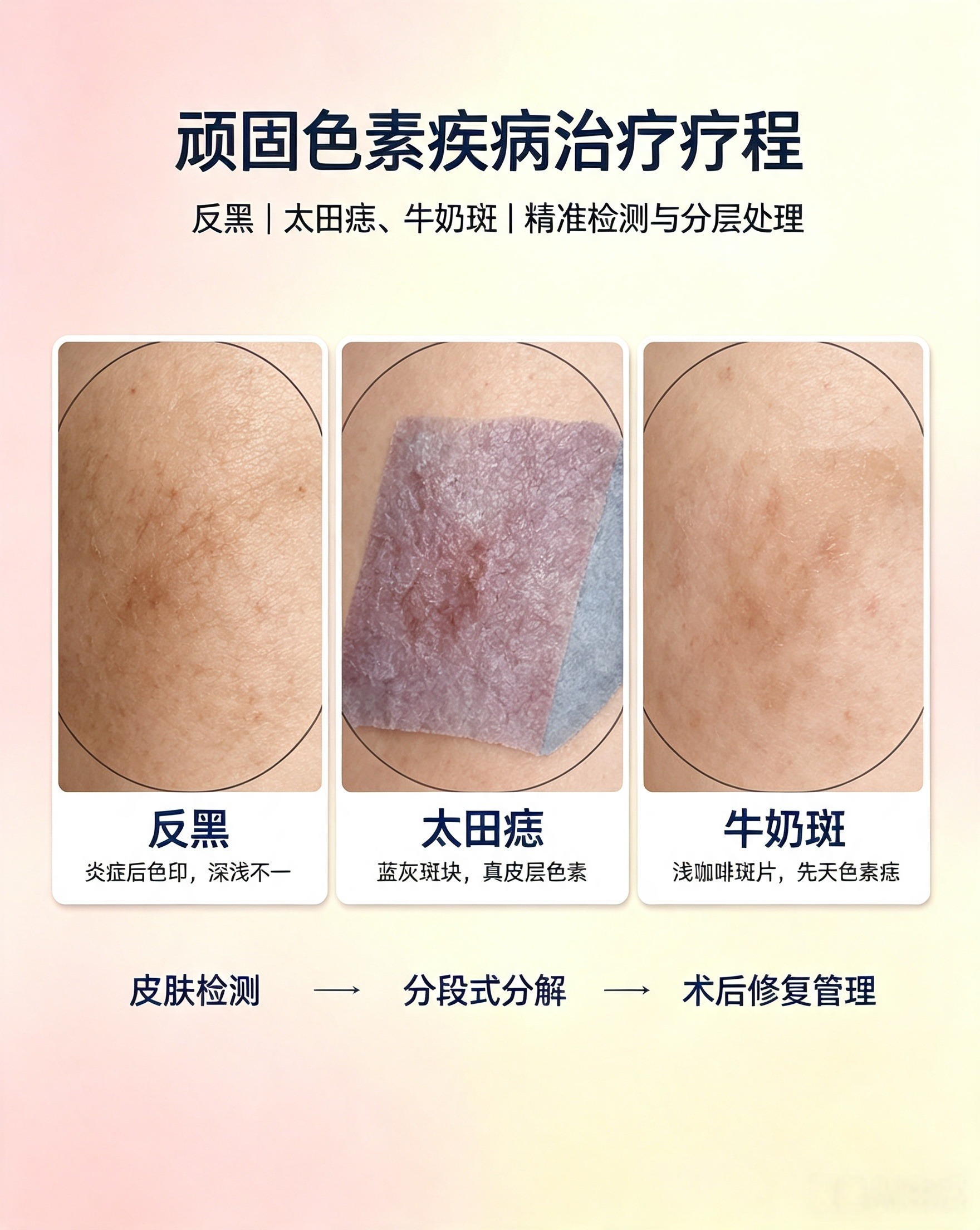
In Hong Kong, many people believe lasers, peels and brightening serums can solve every skin problem. Yet we have seen too many clients who did seek help — they simply tried every method, only to find deeper despair: some with rebound pigmentation that kept worsening; some whose nevus of Ota was misdiagnosed as ordinary pigmentation, with years of treatment and no progress; some with café-au-lait spots (congenital pigmented naevi) who were told by doctors that “nothing can be done”.
Our clinic exists to fill this gap.
We are not an ordinary beauty salon. We are the “final referral station” for skin problems
We focus on the skin cases that most organisations on the market are unwilling to touch, dare not touch, or simply lack the ability to handle — and we are especially experienced in the following three areas:
1. Rebound darkening (Post-Inflammatory Hyperpigmentation): whether it is rebound after laser, post-traumatic pigment deposition, or deep pigment marks from long-term hormonal fluctuation, we use fractional, precision-breakdown techniques together with a personalised repair plan to cut off melanin transfer at the source, rather than stopping at surface bleaching.
2. Nevus of Ota (Ota’s Nevus): this involves proliferation of melanocytes deep in the dermis; traditional surface lasers simply cannot reach it. We use deep-penetrating devices of specific wavelengths to precisely shatter the abnormal pigment cells buried in the dermis, while protecting surrounding normal tissue, so that the blue-grey patches long regarded as a “birthmark destiny” can truly fade.
3. Café-au-lait spots (Congenital Melanocytic Nevus) and various stubborn congenital/acquired pigmented lesions: for congenital pigmented naevi with unclear borders, uneven colour, or accompanying hair growth, we do not rely on a single laser plan. Instead we use a composite, stepped treatment strategy, addressing the lesion by layer, session and depth, gradually metabolising spots once thought “difficult to clear” until they are no longer visible to the naked eye.
Why we can do what others cannot
· Not “one device for everything”: we flexibly combine different wavelengths and energy modes according to the depth, colour, borders and activity of each skin lesion, rather than a one-size-fits-all standard course.
· Diagnosis before treatment: we spend the most time on skin assessment and tracing the cause. Many clients’ “spots” are in fact mixed pigment problems; the cause must be unpacked before treatment is discussed.
· We take on cases others dare not: we are glad to accept “difficult cases” referred by other clinics or salons, and to provide a complete risk assessment and reasonable expectation management.
Our ultimate promise
We do not claim we can treat “every” skin problem, but we do dare to say:
“If even we cannot handle it, we will tell you directly — and then help you look for other viable directions.”
Because more than earning a single treatment fee, what we value is giving every client who arrives with a concern an honest, professional answer that still leaves a way forward.
---
📍 Who it is for
· Those who have had multiple laser treatments, only for rebound pigmentation to worsen
· Blue-grey, dark-brown, poorly defined congenital patches on the face or body
· Those refused treatment by other organisations, or told that “nothing can be done”
· Those looking for a skin-treatment clinic that is not “sales-led”, but truly “pathology-led”
If you or someone close to you is facing a similar concern, you are welcome to come for a consultation with previous treatment records. We will not push a treatment on the spot; we will first help you see the nature of the problem clearly.
Because we believe — behind every mark, there is an answer that deserves to be taken seriously.
Common treatment dilemmas in the market
· Frequent sessions, with an overall course that readily stretches over several years
· The post-treatment rebound-pigment period easily triggers anxiety, and many patients give up midway
· Facial redness, swelling and crusting affect daily social life and work
· Residual pigment, recurrence or colour mismatch is difficult to avoid completely
Our points of differentiation
· Precise diagnosis together with rigorous parameter setting, reducing unnecessary sessions
· Full-cycle care, with proactive follow-up and explanation during the rebound-pigment period, so that patients do not interrupt treatment through misjudgement
· Complete pre- and post-treatment protocols, with more meticulous management of the repair period
· Extensive clinical experience and parameter control, effectively lowering the risk of residual pigment, recurrence and colour mismatch
In one sentence
Most of the market only provides laser operation; we provide full-course guardianship from assessment through to repair.
For deep dermal pigmentary lesions such as nevus of Ota, the difficulty of treatment lies in pigment that is widely distributed and of uneven depth. With precise pre-treatment diagnostic assessment, strict device-parameter control, and a complete client-management system running through before, during and after treatment, we can respond effectively to a range of clinical variables and, while ensuring safety, achieve progressive and controllable pigment fading for the client.
Unlike some organisations that focus only on short-term, visible-to-the-eye improvement while neglecting potential risk control, we insist on rigorous clinical standard operating procedures to address this kind of complex dermal pigment problem systematically, ensuring that every treatment delivers maximum benefit within the bounds of safety.
Post-inflammatory hyperpigmentation can follow lasers, injury or hormonal change. We use staged breakdown plus personalised repair rather than bleaching the surface only.
Nevus of Ota sits in deep dermis; superficial lasers often cannot reach it. Specific deeper wavelengths are used to fragment abnormal pigment while protecting nearby tissue.
For poorly bordered or mixed congenital pigment we use a staged, layered plan rather than a single laser, aiming for gradual fade that is realistic and safer.
Most time goes to skin analysis and tracing causes. Mixed pigment must be unpacked before treatment; we discuss risk and expectations rather than selling a course on the spot.